
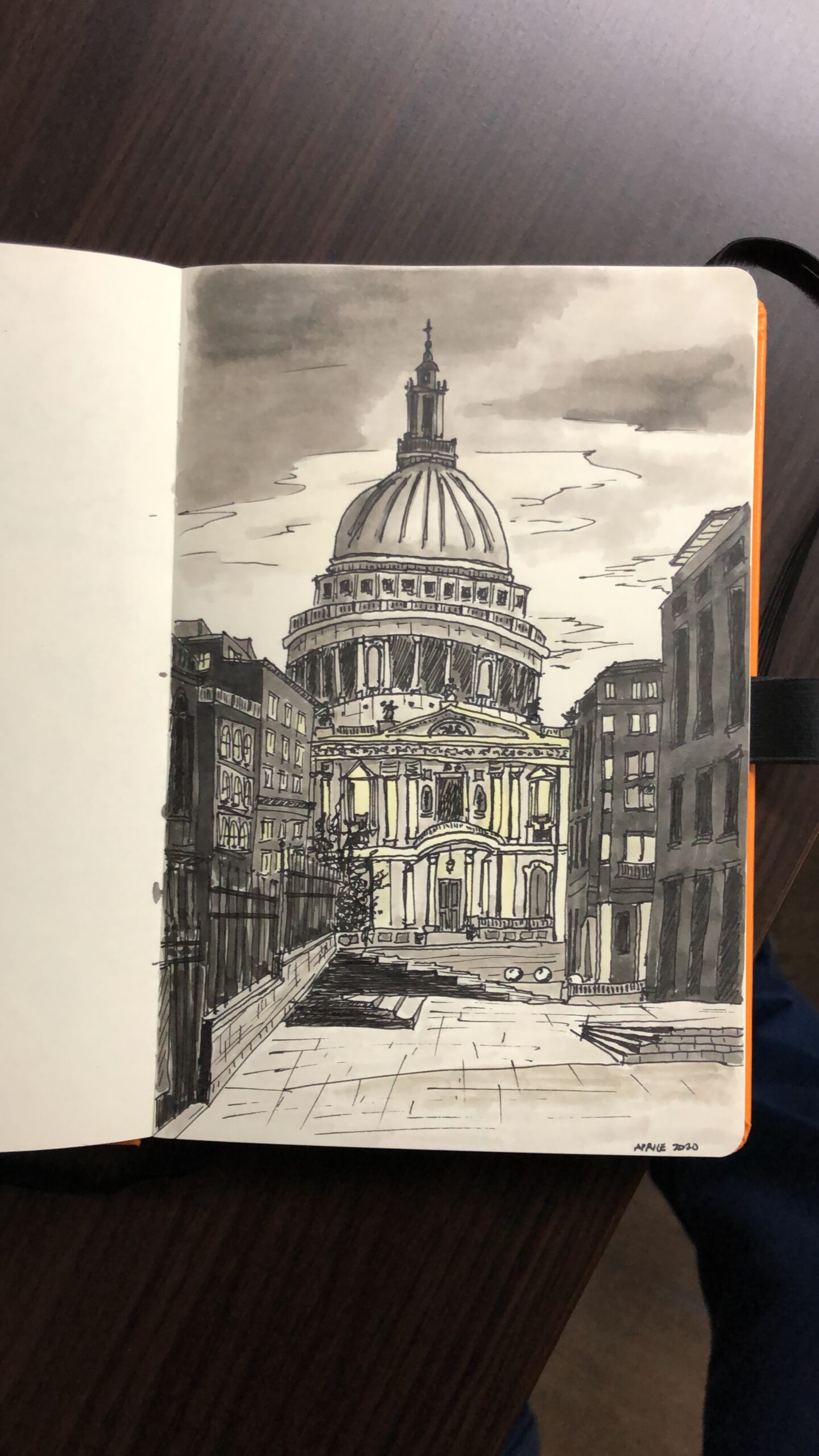
St. Paul’s Cathedral: Capturing London’s Iconic Skyline in Ink and Markers
During my recent visit to London, I found myself drawn time and time again to the majestic St. Paul’s Cathedral. One cloudy morning in April, I decided to dedicate some time to capturing its grandeur through my lens. The weather, though typically London-grey, created the perfect atmospheric backdrop for this architectural marvel.
The cathedral’s dome has dominated London’s skyline for over three centuries, and as I stood there with my camera, I couldn’t help but think about all the historical events this building has witnessed. From surviving the Blitz in World War II to hosting royal weddings, St. Paul’s stands as a testament to London’s resilience and magnificence.
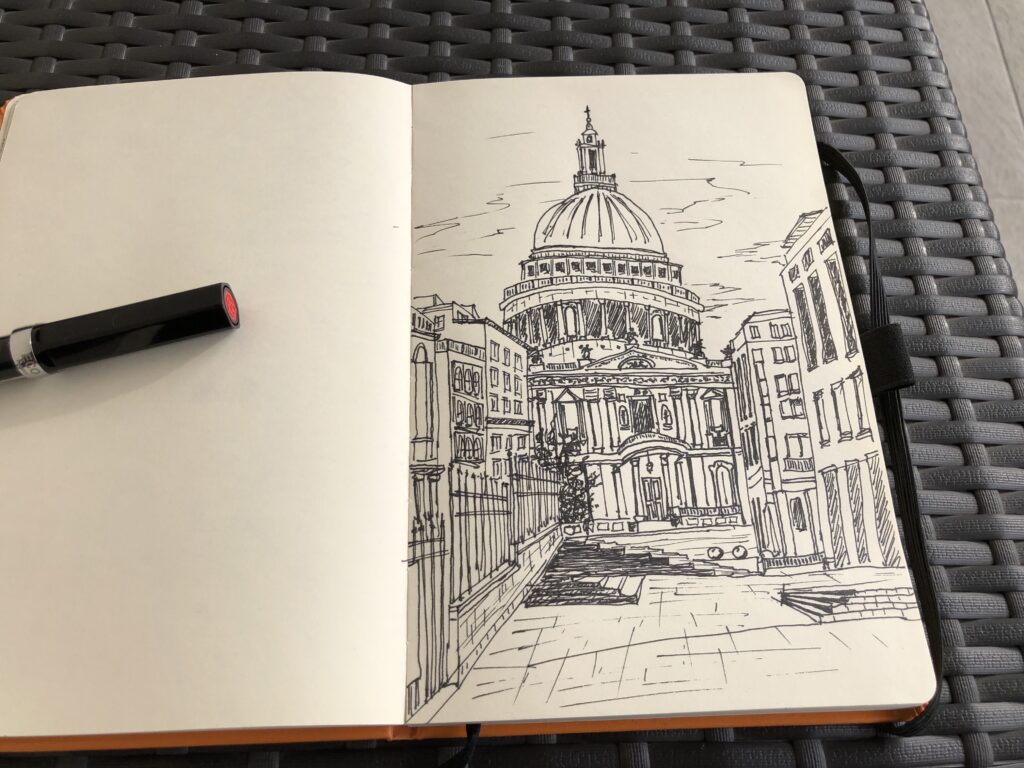
Back in my studio, I decided to transform the photograph into a sketch. I began by carefully laying out the basic structure in pencil. The perspective was particularly challenging – getting the right proportions of the dome in relation to the base of the cathedral required several attempts. The surrounding buildings helped frame the composition, creating leading lines that draw the eye toward the magnificent dome.
The most intricate part came when I started working with the fineliner. Each architectural detail needed careful attention: the ornate columns, the decorative elements around the windows, and particularly the ribbing on the dome. I found myself getting lost in the meditative process of adding these fine details, each line contributing to the overall grandeur of the structure.
For this piece, I chose to work primarily in black and white, using my alcohol markers to create various shades of grey. This monochromatic approach felt appropriate for capturing both the solemnity of the cathedral and the moody London sky. I paid particular attention to the contrast between light and shadow, especially around the columns and under the dome’s ribs, which helps give the drawing its sense of depth and dimensionality.
The surrounding buildings required their own careful treatment. While I wanted them to frame and complement the cathedral, they needed to remain secondary to the main subject. I achieved this by using lighter tones and fewer details on these peripheral structures, allowing St. Paul’s to command attention at the center of the composition.
One of the most satisfying aspects of this drawing was capturing the way the steps lead up to the cathedral’s entrance. These lines help create a sense of perspective and draw the viewer into the scene. The scattered people I included on the steps (mere suggestions of figures rather than detailed representations) help give a sense of scale to the massive structure.
This sketch holds a special place in my travel journal. It’s not just a drawing of a building – it’s a memory of that morning in London, of the people hurrying up and down those steps, of the pigeons gathering in the courtyard, and of the timeless beauty of one of London’s most beloved landmarks.
Looking at it now, I feel I managed to capture not just the architectural details, but also something of the spirit of St. Paul’s – its solidity, its grace, and its enduring presence in the heart of London. The decision to keep it monochromatic seems to have paid off, lending the piece a timeless quality that feels appropriate for such a historical monument.
Every time I look at this sketch, I’m transported back to that grey London morning, standing among the crowds, all of us gazing up at Sir Christopher Wren’s masterpiece. It reminds me that sometimes the most iconic subjects can still offer new perspectives when viewed through an artist’s lens.
Has anyone else tried sketching St. Paul’s? I’d love to hear about your experiences capturing this magnificent building, whether through art or photography. Share your stories in the comments below!