
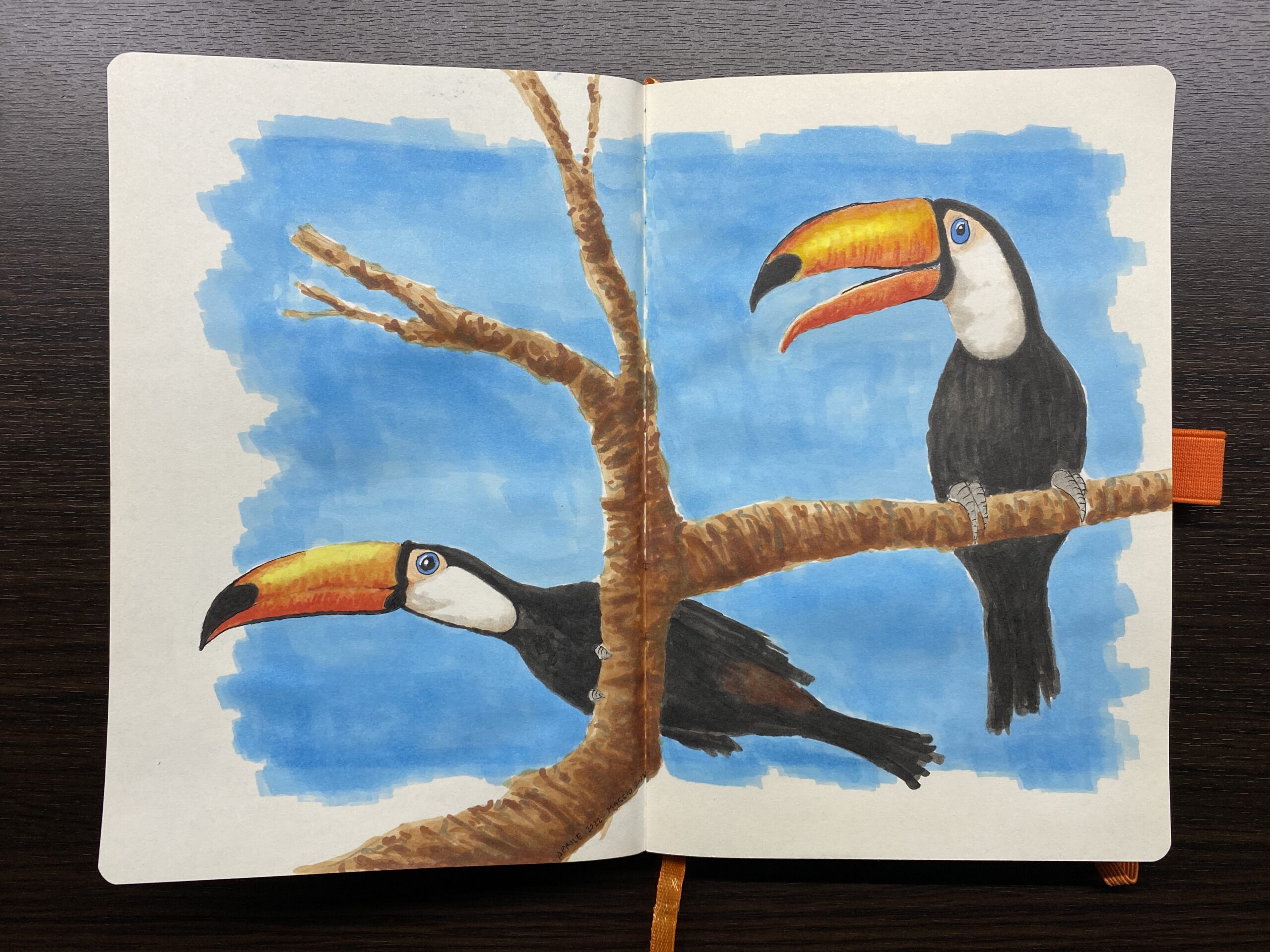
A Study in Toucans: From Thumbnails to Final Illustration
There’s something endlessly fascinating about toucans. Perhaps it’s their almost cartoonish proportions – those oversized, colorful bills paired with their sleek black bodies – that make them such compelling subjects for artists. Recently, I decided to tackle these magnificent birds in my sketchbook, challenging myself to capture not just their distinctive features, but also their characteristic poses and personality.
The journey began with thumbnail sketches – quick, loose compositions that helped me explore different arrangements. I played with various positions and angles, but kept coming back to the idea of two toucans perched on branching limbs. There’s something inherently dynamic about this setup – the way it allows the birds to interact with their environment while creating interesting negative spaces in the composition.
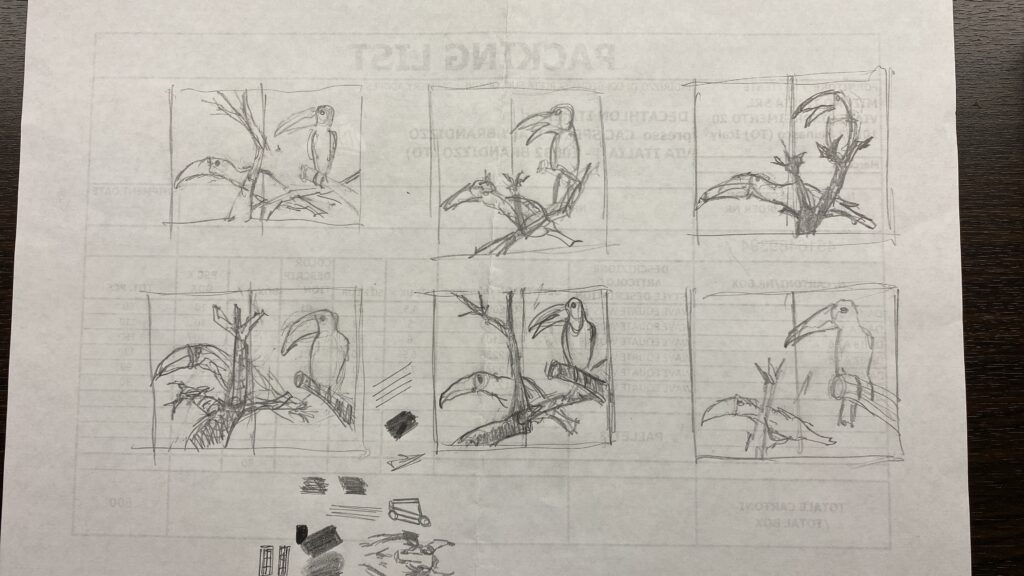
After several iterations, I settled on my final composition: two toucans positioned at different heights on a branching tree, their distinctive profiles creating a pleasing visual rhythm across the spread of my sketchbook. The higher bird would be more upright, alert, while the lower one would be positioned in a slightly more horizontal pose, creating a subtle diagonal line that leads the eye through the piece.
The pencil stage was crucial for getting the proportions right. Toucans present an interesting challenge – their bills make up nearly a third of their total length, and getting this ratio correct is essential for capturing their characteristic look. I spent extra time on their eyes, which are surprisingly expressive, and the subtle curves of their bills, which aren’t just simple triangles but have a gentle arc that gives them their distinctive appearance.
Moving to the fineliner was both exciting and nerve-wracking. There’s always that moment of tension when you first put permanent ink to paper, knowing there’s no going back. I started with the outlines of the birds, carefully defining their shapes and the crucial details of their bills. The tree branches required a different approach – here, I used my fineliner to create texture, suggesting the rough bark with small, irregular lines.
The real magic happened during the coloring phase with alcohol markers. I began with the sky, laying down a base of light blue and building up layers to create that characteristic depth of a tropical day. The branches came next, using warm browns and creating texture by varying the pressure and direction of my strokes.
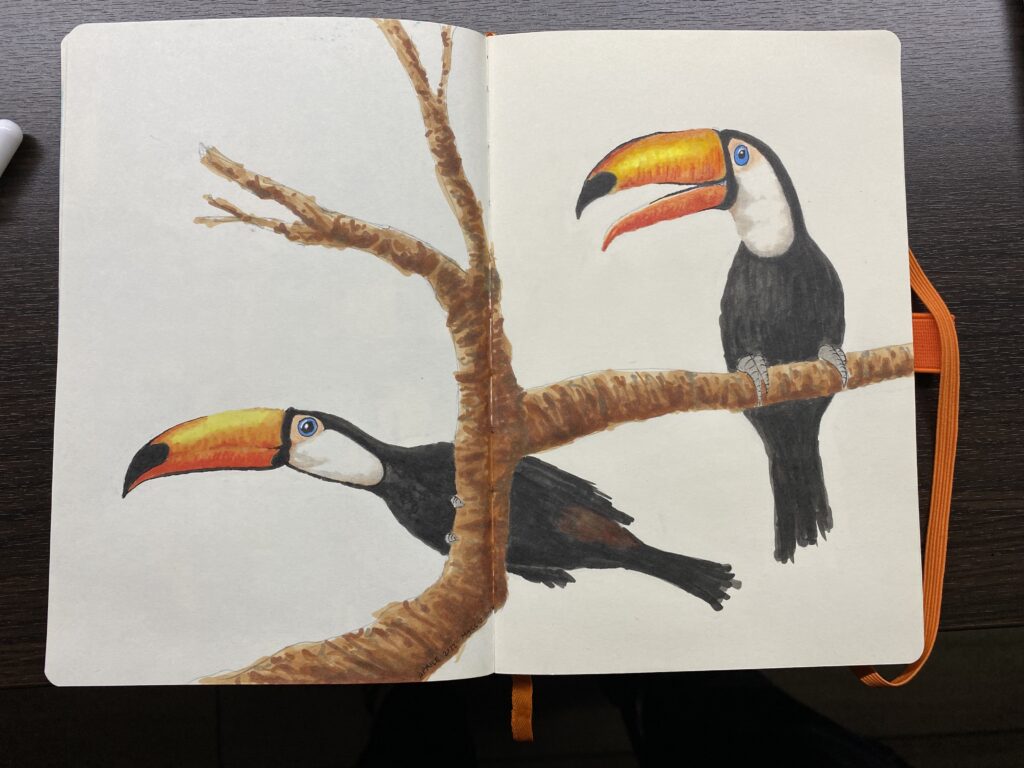
For the toucans themselves, I started with their iconic bills. The challenge here was creating the gradual transition from orange to yellow while maintaining the bright, vivid quality these birds are known for. I worked quickly while the markers were still wet, allowing the colors to blend naturally. The black bodies required a careful touch – too heavy-handed and they would lose all detail, too light and they wouldn’t capture the glossy quality of the birds’ feathers.
What I particularly love about the final piece is how the composition creates a sense of space and depth. The branch structure leads the eye through the image, while the bright blue background helps the birds pop forward. The toucans’ expressions seem to suggest a moment of quiet observation, perhaps scanning their surroundings for fruit or engaging in their morning routine.
Looking at the finished illustration, I’m struck by how these birds manage to look both dignified and slightly comical at the same time. Their perfectly poised postures contrast with their almost oversized bills, creating that characteristic toucan charm that makes them such beloved subjects.
This piece now lives in my sketchbook as a study in contrasts – black against blue, smooth feathers against rough bark, curves against angles. It’s a reminder of the joy in capturing nature’s more flamboyant creatures, and the satisfaction of bringing their unique character to life on paper.
The process taught me a lot about patience in building up layers, the importance of preliminary sketches, and how sometimes the simplest compositions can be the most effective. Most importantly, it reinforced my belief that there’s something special about taking the time to really observe and document the natural world, even if it’s just two toucans on a branch, sharing a quiet moment in the tropical sun.